
Junctions
Almost every road you drive on meets another one somewhere, and how you deal with that meeting is one of the things an examiner watches most closely. Nearly all junctions fall into two kinds, and telling them apart on approach is the first skill to learn.
At a give way junction you must give way to traffic on the road you are joining, but you do not have to stop if the road is clear. At a stop junction you must come to a complete standstill before the line every single time, whether anything is coming or not. That difference is not a matter of judgement: it is the law, and the markings tell you which one you are approaching well before you get there.
The rest of this section deals with what you do once you have identified the junction: turning left into a side road, turning right across oncoming traffic, emerging from a minor road onto a major one, and crossroads, where two junctions meet at once.
Give way junctions
There are three major things to look out for when identifying a Give Way junction:
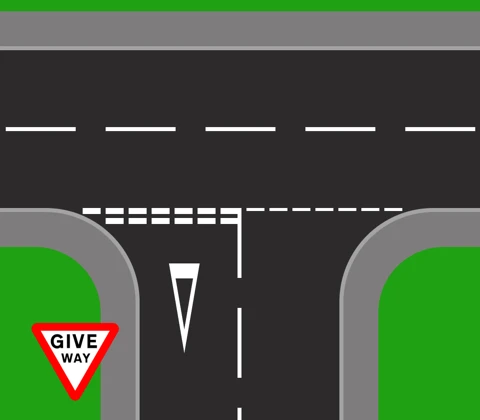
- Two thick, broken white lines painted on the left side of the road, with a single thinner, broken white line across the right side of the road
- A hazard warning sign at the side of the road with the words "GIVE WAY"
- A white triangle painted on the road
Many give way junctions only have the white lines painted on the road. The warning sign and the triangle may or may not be present. Beware of faded lines. Sometimes you have to look very closely to see which markings are present at a junction. Slow right down to give yourself plenty of time to look.
Interestingly, the Give Way sign is the only sign to use an upside-down triangle. This means you should be able to tell which sign it is even if the words are hidden by mud or snow!
Notice also the white hazard warning lines painted in the centre of the road. These lines warn of the presence of a hazard or potentially hazardous situation (in this case the hazard is the junction).
Open or closed?
As early as you can, try to identify whether you are approaching an open or a closed junction. An open junction has very little - if anything - to obstruct your view as you approach (as in the image above). A closed junction makes it much harder to see potential hazards on approach.
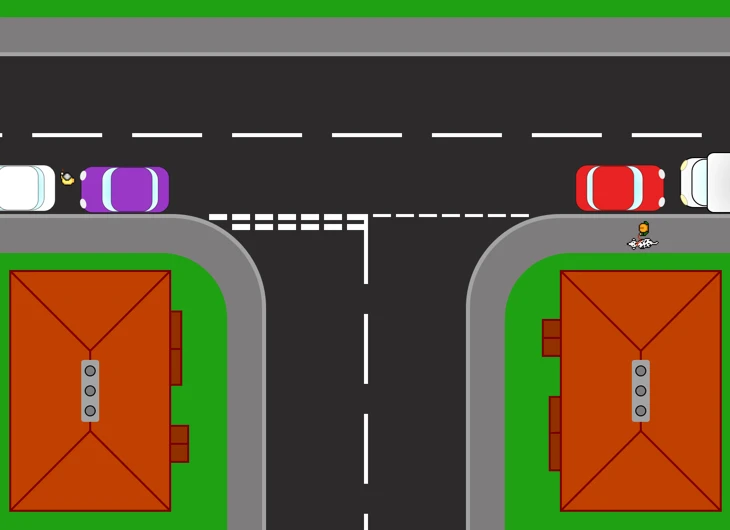
Closed junction
Stop junctions
The clue is in the name: at a stop junction you must stop before the line (it's the law). The common mistake at stop junctions is treat it the same as a give way junction. The reason for doing this tends to come down to one of these two things:
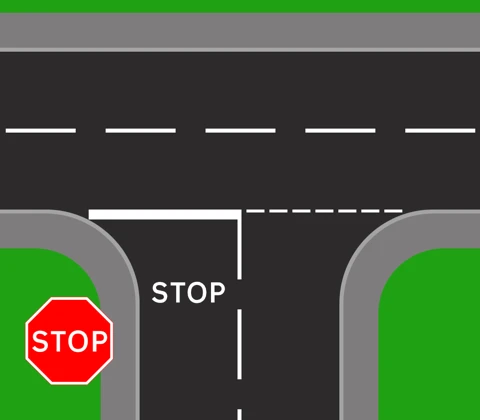
- Failing to identify it as a stop junction
- Failing to recognise the difference between stopping and almost stopping
How to identify a stop junction
- Look out for a big, red, hexagonal sign that says STOP in large white letters
- Look out for the word STOP in printed in very large white letters on the road
- A stop junction has a single solid white line in place of the double broken white lines of a give way junction
Stopping and almost stopping
If you are eager to get away at the junction, it can be a fine line. The trick here is to take your time. It is a stop junction for a reason. Don't just stop behind the line; stop and take a moment. Count to three or put the handbrake on for a second. Anything to make sure that you absolutely, definitely have stopped.
Once you have stopped, you can then treat the junctions as if it is a give way. If your view is obscured, you should edge slowly forwards while alternately looking left, right and (if necessary) ahead. Move off when you can do so without affecting other road users.